Part 5: Honne Tatemae and Wa in Innovation Management - We don't say everything we think

Updated: Sep 22
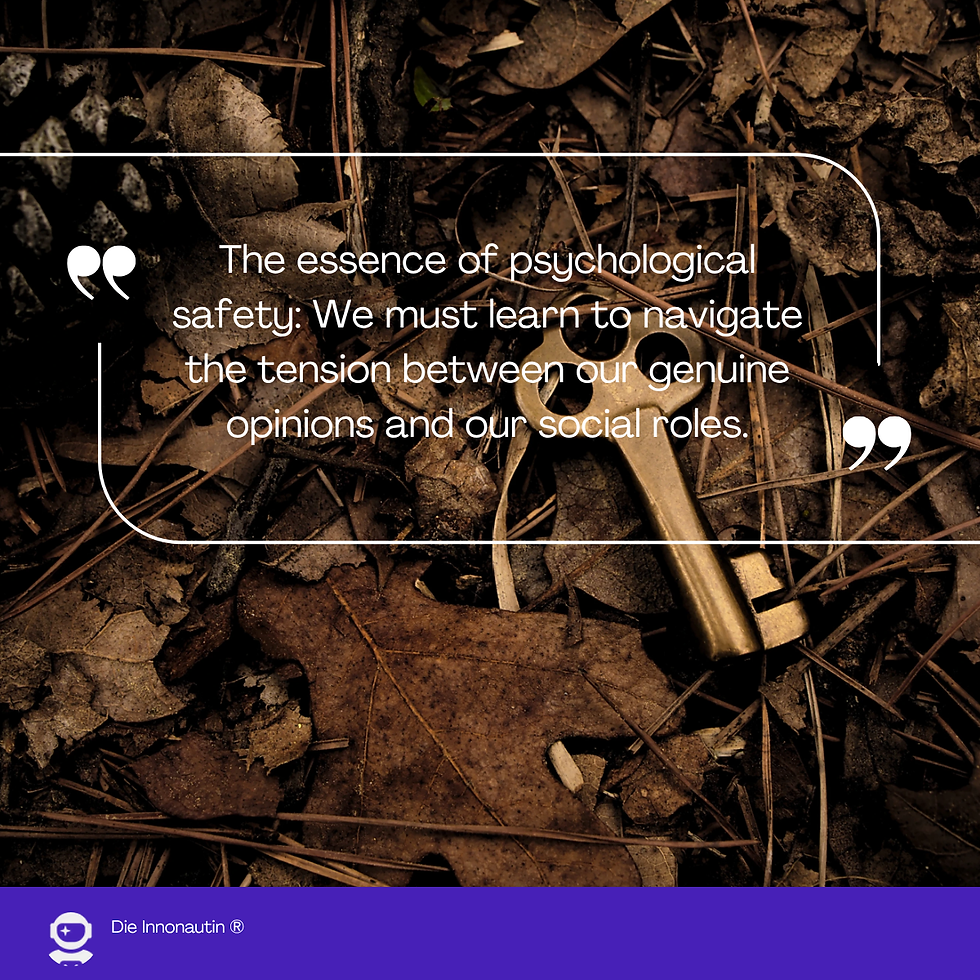
Is psychological safety the buzzword of the decade? Create an environment where people can speak freely, admit mistakes, and dare to try new ideas... In principle, that's absolutely correct. But what if this promise falls short? What if the core of the problem isn't a lack of safety at all, but rather that we've never learned to navigate the age-old tension between genuine opinion and social role?
Honne Tatemae and Wa for clarity in innovation management
Today, in part 5 of the Japanese Innovation Map ( link to the other parts ), I will focus on two further principles that address precisely where many Western concepts of psychological safety reach their limits: Honne and Tatemae, as well as Wa.
They show us a Japanese answer to the question of what psychological safety can mean. It's about dealing intelligently with the fact and the reasons why people often don't say what they really think.

People often don't say what they really mean. They act according to their social roles and what is expected of them.
Honne and Tatemae – The tension between true self and social role

Honne (本音) literally means “true sound”: your real opinion, your true feelings, which you usually only show to people you really trust.
Tatemae (建前) is the “facade” or public stance: what you say because it is expected, or to avoid hurting anyone or losing face.
This tension is deeply rooted in Japan and originates in a society where group harmony has been paramount for centuries. It is not a modern phenomenon, but a pattern that was already established in feudal times and especially in the post-war period (see Wikipedia: Honne and Tatemae). Honne Tatemae is not a contradiction but a cultural tool for maintaining harmony without completely abandoning authenticity.
In practice, this can look like this, in my experience: Japanese people often praise what they like. They don't mention what they don't like. By omitting these points, the criticisms are still clear, and no one loses face. Tatemae isn't hypocrisy in the Western sense, but rather a conscious approach to the fact that not every truth is helpful at all times.
In the official debriefing, for example, one stakeholder says: “The prototype has some interesting approaches. We need to delve deeper into certain areas” (Tatemae). To a Western innovation manager, this initially sounds positive. However, the experienced Japan expert knows: The lack of specific praise is a clear sign of concerns.
The real Honne only surfaces later in an informal conversation, perhaps over dinner after work, among trusted colleagues: "I think the user-friendliness might not be quite there yet. We could risk high dropout rates if we don't do x in the user interface and test y." By consciously omitting this in the plenary session, the atmosphere remains constructive, and no one has to publicly justify themselves. For us in the West, this tension often leads to deep frustration and misunderstandings, for example, in negotiations. We only hear the surface and later wonder why ideas aren't implemented or the expected decision isn't communicated. In reality, it's simply not there yet. As an innovation manager in a Japanese environment, you learn over time to recognize these subtle signals and deliberately build secure personal relationships in which the Honne is openly expressed.
Those who have internalized the principle of Honne Tatemae understand how fundamentally important personal relationships are in the Japanese business world.
Honne and Tatemae in Innovation Management
For you as an innovation manager, Honne Tatemae is particularly relevant because innovation is always accompanied by uncertainty, criticism, and differing interests. Especially in idea evaluation, the feedback process, and conflict resolution, it becomes clear how dangerous it is to only listen to Tatemae.
In concrete terms, this means that in your daily work you often receive polite agreement or vague formulations ("That's interesting...") in workshops and meetings, even though the real honne is quite different. As an innovation manager, you therefore need the ability to consciously create spaces in which Honne can emerge, for example through brainwriting or small, informal gatherings before or after the official meeting.
Those who ignore this tension risk good ideas dying unnecessarily or facing costly surprises later on. Those who consciously utilize it win.
Wa (和) is more than "not arguing"

It is the active enabling of genuine opinions without tearing the group apart.
The origins of Wa reach far back into Japanese history. As early as the 7th century, Prince Shotoku Taishi formulated in the first Japanese constitution: "Wa should be valued and strife avoided." Wa became a central cultural virtue in a society characterized by close-knit communities, limited resources, and strong hierarchies. It is not about superficial homogenization, but about a conscious, active, and harmonious coexistence that strengthens the group while simultaneously allowing space for differences.
In Japanese companies, Wa is practiced daily. At Toyota or Sony, this is evident in the lengthy preparation of decisions through Nemawashi: Key individuals are consulted beforehand, their genuine concerns (Honne) are heard, and solutions are sought that do not divide the group. This results in a decision that is supported not only formally but also emotionally. No one has to lose face publicly, yet critical voices are taken seriously. Wa is not a soft "everyone is happy" approach, but a highly professional instrument that enables innovation without jeopardizing the social structure. It allows for individuality while simultaneously demanding teamwork.
Wa in innovation management
For you as an innovation manager, Wa is particularly relevant because innovation always creates tensions: between ambitious ideas and existing structures, between different departments, between special personalities and real obstacles.
Specifically, Wa in your daily work means consciously creating opportunities where genuine opinions (Honne) can be expressed without anyone losing face. This is reflected in how seriously you lead meetings, solicit feedback, or resolve conflicts during idea evaluation. Instead of relying on direct confrontation, you utilize Wa by also conducting one-on-one conversations, employing quiet methods like brainwriting, or structuring retrospectives in a way that allows criticism to be formulated constructively and without losing face.
Wa helps you create genuine psychological safety by enabling you to actively balance tensions. This transforms potential obstacles into real opportunities for innovation.
Stronger together: Honne Tatemae and Wa in combination with Western innovation methods

Honne Tatemae acknowledges and respects the natural tension between genuine opinion and social role. This prevents naive openness, which in hierarchical or conflict-ridden environments quickly leads to loss of face or gridlock. Wa, on the other hand, shows how to deal with this tension constructively: It's an active balancing act of cultivating individuality while always prioritizing the well-being of the team.
Together, they enable a deeper form of psychological safety. This is not the Western version of "anything can be said and no one is wrong," but a more mature tolerance that requires both authenticity and solidarity.
Honne Tatemae + Brainwriting 6-3-5 + Pre-Mortem
Brainwriting 6-3-5 was developed by Bernd Rohrbach in the 1960s: 6 participants, 3 ideas each, 5 rounds of further development. This generates a large number of ideas in several rounds without discussion or dominance.
Pre-mortem is a technique popularized by Gary Klein, in which the team at the beginning of a project considers together: "Imagine the project has failed in six months – why?"
For these essential reasons, these two methods are particularly well suited to Honne Tatemae
Both methods are deliberately designed to reduce group pressure and social expectations.
Brainwriting 6-3-5 reduces the social pressure to immediately present a public, preferably cool and accepted idea (Tatemae). Everyone can first put their true thoughts (Honne) down on paper undisturbed before sharing them. This leads to more honest ideas that aren't weakened by polite facades during their development.
Pre-mortem creates a safe space where critical concerns can be voiced early and openly without anyone losing face, since these are hypothetical assumptions. The method is a perfect fit for Honne Tatemae because it brings the real Honne to light before Tatemae dominates the discussion, thus leading to deeper risk analyses.
Wa + Liberating Structures + Start-Stop-Continue
Liberating Structures are a collection of over 30 simple meeting formats developed by Keith McCandless and Henri Lipmanowicz that break down hierarchies and actively involve all participants (e.g., “1-2-4-All” or “Troika Consulting”).
Start-Stop-Continue is a classic retrospective method from agile environments, in which the team discusses what should be continued, stopped, or restarted. Both approaches aim for greater participation and a better learning experience.
For these essential reasons, these two methods are particularly well suited to Wa
Wa lends depth and sustainability to these methods: It's not just about more participation, but about consciously defusing conflict so that genuine opinions can be heard without dividing the group. This combination transforms Western participatory tools into instruments that foster both openness and cohesion, thereby enabling a genuine, sustainable culture of innovation.
Liberating structures promote active participation and dismantle hierarchies by giving all voices an equal platform. Wa ensures that this openness does not lead to conflict, but rather to conscious cooperation – thus creating a space where genuine opinions can be expressed without loss of face.
Start-Stop-Continue enables structured reflection, where the team jointly discusses what should be maintained, stopped, or restarted. Wa gives this method its Japanese depth: she transforms the retrospective into a tool that simultaneously strengthens openness and cohesion, thereby fostering a sustainable learning and innovation culture.
How-to: Practical application in four examples

When evaluating ideas : Begin your next brainstorming session with Brainwriting 6-3-5 – a silent round where everyone can put their thoughts down on paper undisturbed. You give space to the Honne (the collective) before the Tatemae (the collective) takes the stage. Later, you moderate the discussion with Wa (the collective) in mind: You ensure that even unconventional contributions or individuals always keep the "we" of the project in focus.
In the feedback process : After important workshops, introduce short, intimate "Honne check-ins" – small rounds in which you ask: "What were you really thinking, but didn't say out loud?" The goal is not judgment or soul-baring, but surprise effects (also to make you smile) and cohesion.
In conflict resolution : Use pre-mortem thinking as a shared look into the future: "Let's imagine this project fails – why?" Instead of direct confrontation, you and Wa look for risks in advance.
In your daily meeting culture : Use Liberating Structures to ensure all voices are heard. Wa reminds you to consciously schedule time for informal conversations after the official part of the meeting.
Small, conscious gestures like these transform the tension between genuine opinion and social role from an invisible barrier into a source of creativity and connection.
Food for thought
Honne Tatemae Wa Innovation Management – how do these two things fit together? Take a moment and ask yourself: In which meeting last week did you only hear "Tatemae" (individualism/uniqueness)? And where could you have had more genuine "Honne" with a small change? Which of your routines could gain strength through a balance of individuality and team spirit?
The Japanese innovation map shows us that true psychological safety isn't created by rules alone, but by boldly and intelligently navigating human dynamics. Try one of the four impulses over the next few weeks. You'll feel how not only the quality of your ideas but also the quality of your collaboration changes.
The updated map with all twelve principles is available for you to download. I'm very curious to hear what insights you gain from it.
Frequently asked questions about Honne Tatemae and Wa
Ask:
Isn't Honne Tatemae simply hypocrisy?
Answer:
No, it's a cultural tool for maintaining harmony without completely abandoning authenticity. It's about finding the right time and framework for genuine opinions, which is very valuable in complex innovation processes.
Ask:
How can I live Wa without diluting my own ideas?
Answer:
Wa doesn't mean withholding your own ideas, but rather contributing them in a way that the group can support. It's the art of formulating criticism and new ideas in a way that unites rather than divides. This is precisely what strengthens your innovative capacity in the long run.
The next and sixth part of the series deals with the "Improvement" cluster with Kaizen and Kaikaku: "How does sustainable progress come about?" Stay tuned. It's worth it!
👉 Click here for the other parts of this blog series: Japanese Innovation Map
⏰Don't want to miss a post? Then sign up for the newsletter : Blog | Innovation & Japanese Methods – The Innonaut
📃Do you want all 12 x 24 principles at a glance?
or
📃Want more details on all the 12 x 24 principles?
Here you will find both free and paid downloads:
* Marked images created with Grok Imagine by xAI
Dr. Babette Sonntag is an innovation manager, keynote speaker, and "The Innonaut." She helps managers in medium-sized businesses who want to initiate something new but are stuck, using Japanese spirit as a boost.
Please note: This text is translated into English by using Wix Translation and DeepL- I apologize for any mistakes in this text I may have overlooked.


Comments