Innovation on paws: New approaches for coaching

Updated: Sep 22

Innovation isn't exclusive to technology or product development; it also allows us to find new approaches for coaching. The coaching market is changing, coaching has many faces – and sometimes even four paws.
Can you imagine learning from a furry friend how to become more self-confident and stand up for yourself in the workplace? This idea is new and fascinating to me. As an innovation manager, I was immediately enthusiastic.
To better understand this type of coaching innovation, I spoke with Dorothea Brandes from Coaching with Dog & Heart : She radically rethinks team development, organizational development and individual potential development, relying on a co-trainer who doesn't speak, but communicates all the more clearly.
But read for yourselves:
Dear Doro, "Coaching with Dog & Heart" sounds unusual. What exactly is this and what makes your approach innovative?
For me, innovation does not mean constantly inventing new methods, but rather, in a nutshell, enabling learning processes under uncertainty and making them more effective. Dog-assisted coaching enables precisely that: through immediate feedback, beyond hierarchy, evaluation, and self-presentation.
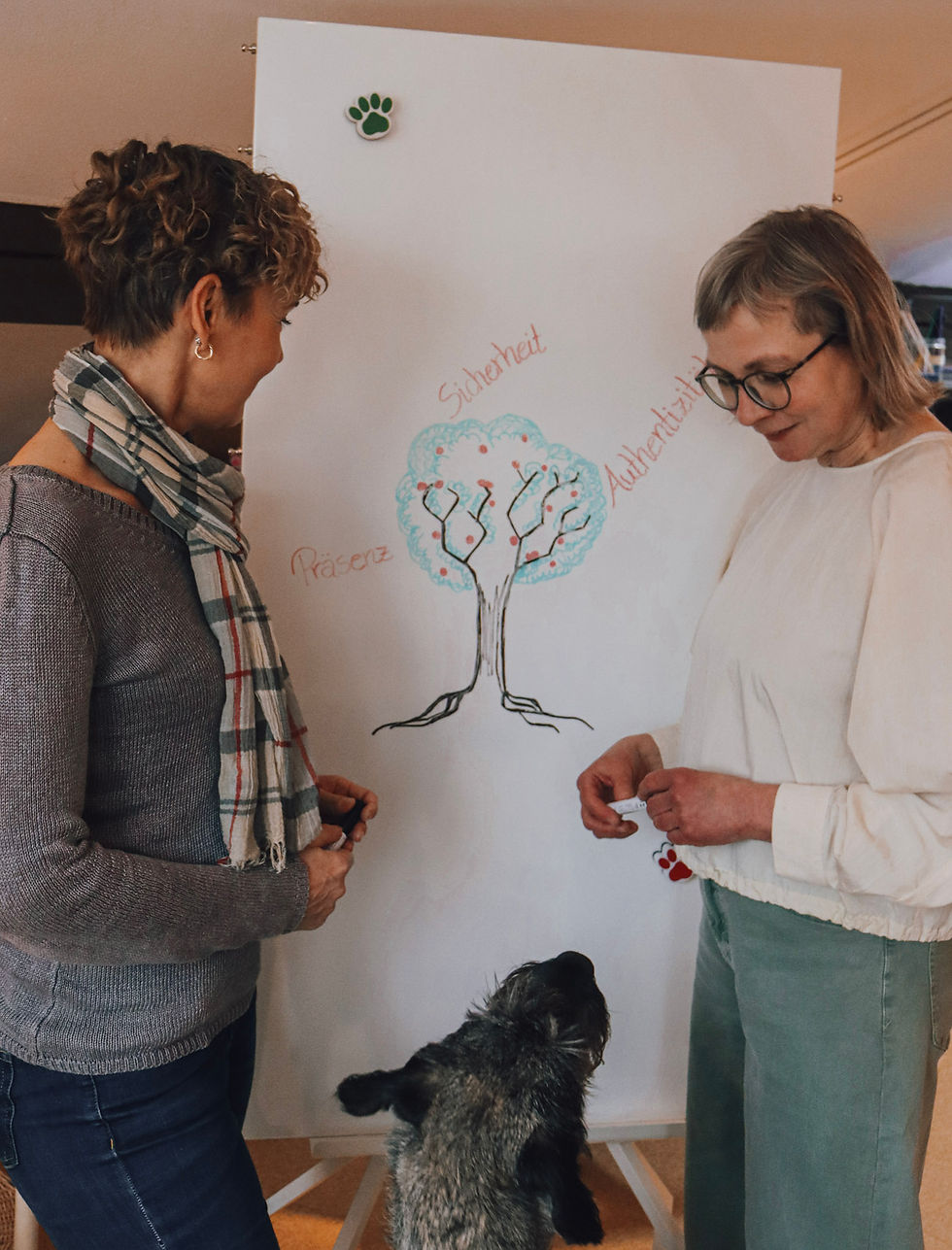
I combine classic systemic coaching with the immediate, nonverbal feedback of my therapy dog Martha. She acts as a co-coach, reflecting the behavior and emotional state of the coachee—directly in the moment, honestly, and without judgment.
The key difference to conventional coaching approaches is that self-reflection does not primarily arise in conversation, but in experience. Through Martha, the coachee immediately learns what effect their behavior has and whether their words and body language are consistent. As a typical Giant Schnauzer, Martha does not try to ingratiate herself, but is independent, direct, and clear. I provide support in interpreting Martha's signals.
"When you engage with Martha as a four-legged coach, an exceptionally powerful form of intervention emerges."
How exactly does that work? Do I have to perform tasks and then Martha reacts to me?
What often remains abstract in traditional coaching processes becomes visible and tangible when interacting with dogs. Animals do not apply human values, which is why their feedback is rarely perceived as instructive or manipulative. The interpretation of the experience naturally takes place in the coaching process between the coachee and me; Martha cannot do this.
You can imagine it like this:
It is often in simple situations that Martha, as co-coach, clearly reflects what usually remains hidden or unspoken in everyday working life.
For example, when I ask the coachee to lead Martha through an open space or a small obstacle course without a leash and without verbal influence, this does not work through commands, but through inner clarity and presence in the moment. If the coachee shows uncertainty or inner restlessness, Martha does not orient herself, becomes uncertain, or takes the lead herself. If the coachee becomes more focused, calmer, and clearer, Martha is able to follow with concentration. This behavior is not a judgment, but a direct response to the inner attitude. In the subsequent discussion, we reflect on the parallels the coachee recognizes with their lateral or disciplinary leadership role.
Another example: In a small group setting, I ask the participants to observe how Martha reacts to those present: closeness develops, distance remains or changes, there is attention here, excitement or uncertainty there. Without judgment, it becomes clear how much presence, openness, and mood can have an effect. The dog provides honest, non-judgmental feedback on the relationship and self-regulation. There is no "right" or "wrong." This experience serves as a starting point for discussions about expectations in collaboration, feedback culture, trust, and psychological safety in the workplace.
"Thinking, feeling and acting come together in dog-assisted coaching."
Especially in our often overly intellectualized and digitally streamlined world, this is a crucial difference compared to purely language-based methods. Building on this foundation, truly holistic development becomes possible, whether in a personal or professional context.
How did you come up with the idea of bringing Martha on as a co-coach and find new approaches for coaching? Was there a key moment?
In my work with people—whether in my role as a conflict mediator or in team development—I find that although a lot is said, not everything always feels right. In the professional environment in particular, a lot of energy is often spent on maintaining a façade in order not to show any perceived weakness or vulnerability. Unlocking these contradictions and opening people up to reflecting on themselves in a benevolent way and finding their own path to problem solving or personal development can take a lot of time. Or you can stay on the surface of the issues and simply “pretend.”
At the same time, I have observed how clearly Martha reacts to inner states: not to words, but to attitude, presence, and congruence. I first experienced this myself, and people who live with a dog know that dogs mirror their own behavior.
The key moment came during a training seminar on body language communication with dogs. A simple exercise that I had often done was to be performed in front of a group. The topic was cooperation. I sat on a chair in front of Martha and hid a piece of food in each hand, to the right and left of my body. The dog had long since sniffed out the food, but was supposed to detach herself from the stimulus, or in other words, this staged conflict, and seek brief eye contact with me. This would have been the moment of cooperation, and I would then have given Martha the food reward to reinforce this learning experience positively. I wanted to do everything “right” and became nervous, my breathing shallower. The little devil “expectation” sat on my shoulder. What happened next? Martha reacted immediately: barking, jumping up, biting my jacket, clowning around. She almost knocked me off the chair. A giant schnauzer in excitement is no fun...
Then, at least according to my memory of this, in my opinion, inglorious incident, I somehow managed to finish the exercise and was glad when it was over. In the debriefing, one participant said, “When Martha was so excited, what did you do?” I didn't remember. She answered herself: “You became very calm. When Martha was fast, you became slow and deliberate, and then it became easy.”
That's when I realized: I don't have to manage the dog's behavior, but rather shape my own mood – and radiate it.

"Impact always begins with myself. That was my turning point, my personal Martha moment ."
Many companies are looking for ways to become more innovative. How does your approach support courage and creativity ?
In dog-assisted coaching, people experience firsthand how they come across: How clearly do I communicate? How do I deal with uncertainty? How much trust do I give and how much do I radiate?
"Innovation needs people who are courageous, open minded and self-regulated."
And organizations need a culture in which mistakes are not only tolerated but used as learning opportunities. In a world full of ambivalence, uncertainty, and dynamism, the ability to develop and implement ideas is more important than simply reproducing knowledge.
Dog-assisted coaching trains precisely these skills in an experience-based manner: self-awareness, relationship building, intuition, and taking responsibility for one's own impact.
What role will emotional intelligence and "animal impulses" play in the workplace of tomorrow?
I am convinced that emotional intelligence and the management of emotional and mental resources will become core competencies in the professional world. By this, I mean the ability to consciously use, regulate, and deploy these resources—not as a "soft skill," but as a strategic and tactical capability. The more complex, dynamic, and uncertain our work environments become, the more important self-awareness, the ability to empathize and set boundaries, and genuine connection will be. These qualities, as a whole, help us become more resilient.
“Animal impulses” help not only to discuss but also to experience emotional and mental resources. They get people out of their heads and bring them into contact with themselves and others.”
For leadership, collaboration and innovation, this means:
🔹Less control, more presence
🔹Less show, more consistency.
It is important to adopt a value-based approach: animals are co-coaches, not tools. Their well-being comes first—as a specialist in dog-assisted intervention, this goes without saying for me.
Conclusion: Doro and Martha are setting new standards, and innovation doesn't stop with the new product.
The world of business is changing rapidly: digitalization, AI, and remote work present us with new challenges. Competition for talent is growing, and companies are looking for ways to develop, retain, and inspire their employees.
Standardized approaches reach their limits here. Individual needs and complex situations demand flexible, tailored concepts. At the same time, the need for emotional intelligence, resilience, and genuine connection is increasing.
Coaching programs play an increasingly important role in employee development and retention, but they must be tailored to the individual.
Innovative methods such as dog-assisted coaching offer a crucial added value for people, teams and organizations in this area.
Dog-assisted coaching creates new perspectives, strengthens the credibility of coaches, and enables development that truly gets under your skin.
Perhaps sometimes all it takes for true innovation is a cool dog's nose—ready to show you what you're really made of.
Are you ready to let a furry coach make you braver?

More about Doro and Martha:

Dr. Babette Sonntag is an innovation manager, keynote speaker, and "The Innonaut." She helps managers in medium-sized businesses who want to initiate something new but are stuck, using Japanese spirit as a boost.
Please note: This text is translated into English by using Wix Translation and DeepL- I apologize for any mistakes in this text I may have overlooked.


Comments