Part 3: Nemawashi and Gemba in Innovation Management - Why starting slowly leads to faster progress

Updated: Sep 22
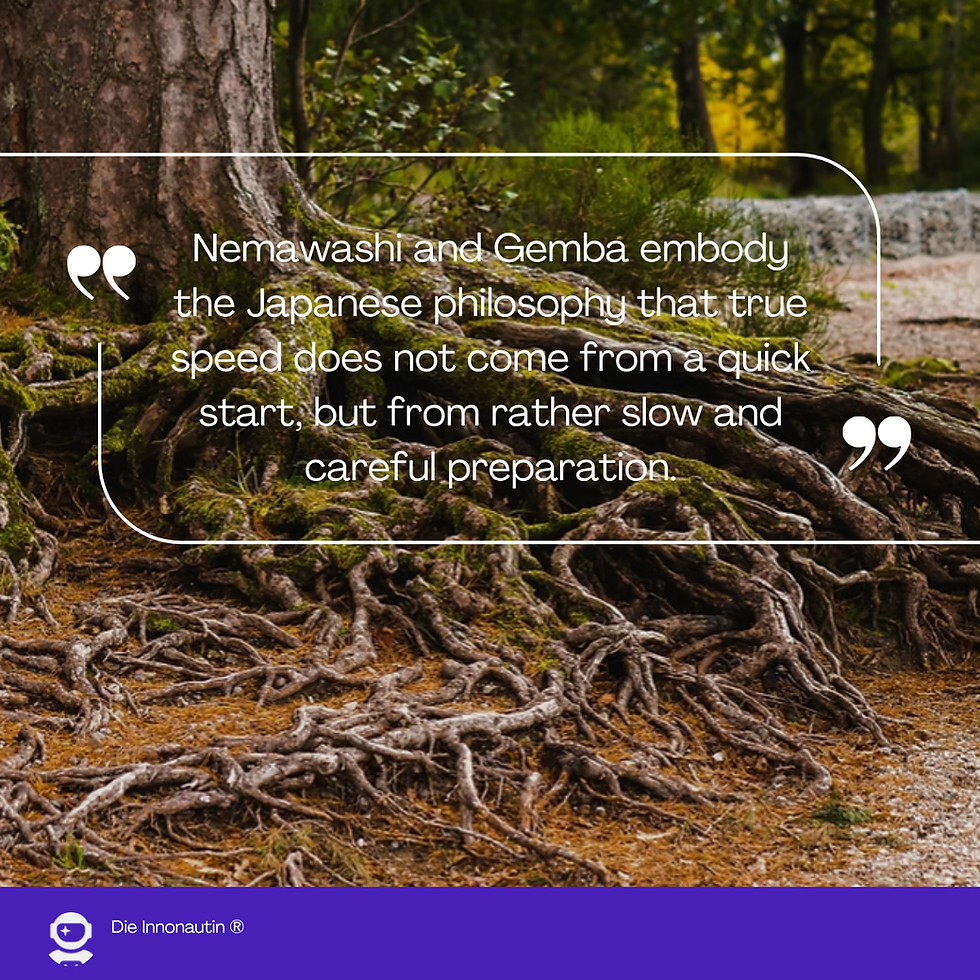
How does one start slowly and arrive faster? What do Nemawashi and Gemba actually mean in innovation management?
I've witnessed decision-making processes in Japanese teams where small talk took up most of the meeting, but the actual decision was then made rather unspectacularly in just a few minutes. This wasn't because the decision was unimportant, but because all participants had already agreed on what would be decided. This process is called Nemawashi.
In Germany, on the other hand, I've experienced brilliantly conceived ideas and professionally polished elevator pitches – only for the presentation to end with a polite nod and nothing to happen. Just months of silence, which causes good ideas to fizzle out.
Nemawashi and Gemba in Innovation Management
In Part 1 ( link to blog post ), I introduced the twelve principles of the Japanese innovation roadmap. In Part 2 ( link to blog post ), Ikigai and Mono no aware demonstrated how purpose and serenity deepen our Western methods. Today, in Part 3 , I will focus on two principles that fundamentally change the transition from idea to actual implementation: Nemawashi and Gemba . They embody a powerful Japanese contribution to innovation management.
"Slow down deliberately first, in order to arrive all the more safely and quickly."

Nemawashi in innovation management: The invisible power of root work
Nemawashi (根回し) literally means "walking around the roots." The term originates from traditional Japanese gardening: Before a valuable tree is transplanted to a new location, the soil around its roots is carefully loosened, damaged parts are gently cut away, and it is prepared for its new environment. Only in this way can it continue to grow healthily.
In a business context, Nemawashi describes the informal process of consensus-building prior to a formal decision. It involves speaking with relevant stakeholders individually and calmly. The important thing is not to convince the people involved, but to truly understand their perspectives, concerns, interests, and suggestions for improvement.
This principle is deeply rooted in Japanese values: respect for others, harmony (Wa), and the belief that a decision is only good if it is supported by the people it affects. It signals: "Your perspective is important. I will take the time to listen to it and consider it before making a proposal."

Nemawashi in Innovation Management
In the day-to-day realm of innovation, nemawashi primarily means one thing: you consciously invest time in informal preparation before an idea is officially presented. Instead of throwing a finished presentation into a large meeting, you conduct quiet one-on-one conversations with the most important stakeholders beforehand.
You don't ask, "Do you think this is a good idea?", but rather, "What concerns do you have? What would make this idea difficult or valuable for you and your team?" This is how you build genuine understanding, support, and shared responsibility. The result: Your innovation projects don't encounter hidden resistance at the crucial moment. Nemawashi transforms "my idea" into "our idea."
It is important to give others time to consider the proposal and encourage them to provide constructive feedback. Such an investment of time can build support and collaboration.
Time is consciously invested in relationship building, which essentially involves listening to and understanding different viewpoints.
At Toyota, for example, this preparation phase can last nine to ten months. What at first glance appears to be a delay later leads to impressive speed and stability in implementation, because obstacles were identified and resolved in advance.
For you as an innovation manager, Nemawashi means:
Make a conscious effort to set aside time for personal conversations.
Talk openly about your new idea with others early on.
Consciously free yourself from the need to quickly present a formal result.
Gemba in Innovation Management – Go and see for yourself

Gemba (actually "genba" 現場) simply means "the real place." Its central principle is part of Kaizen and is called Genchi Genbutsu, roughly translated as "go and see for yourself" (more on this in my blog post Kaizen Meets Shinto: How to Create More Innovation with Japanese Traditions ) . Instead of relying on reports, presentations, or dashboards, managers and teams leave their offices and go where the real value creation takes place: to production, to the customer, to the everyday lives of users.
This principle, too, expresses deep respect: respect for reality and for the people who work there every day. It expresses the belief that no one, not even the highest-ranking executive, knows the truth better than those who are directly involved.
Gemba in Innovation Management
Taiichi Ohno, one of the architects of the Toyota Production System, has repeatedly emphasized:
"Go to the scene of the crime. The answer lies there, not in your office."
Sony has lived by this approach for decades: from the development of the Walkman to modern imaging and sensor technologies. SoftBank also uses intensive Gemba observation to build an understanding that goes beyond mere numbers in complex tech investments.
For you as an innovation manager, Gemba means:
Leave your office and go to where your new solution will later be used.
Ask questions there to better understand their working methods and challenges.
Don't rely on reports from third parties.
Stronger together: Nemawashi and Gemba combined with Western innovation methods
Both principles are highly effective on their own. Together, they form a strong foundation: Nemawashi prepares the human ground, Gemba provides the real basis. They embody the Japanese serenity that true speed doesn't arise from the beginning, but from careful preparation.
We can unleash particular strength by combining these two Japanese principles with appropriate Western methods:
Nemawashi + elevator pitch and stakeholder mapping
The elevator pitch (a short, compelling summary of an idea; see also my blog posts "Persuading in a Pitch: Better Communication with Just 4 Building Blocks" and "Life Is a Pitch... ") and stakeholder mapping (a systematic analysis of the influence and interests of those involved) are structured Western tools. They help to communicate ideas clearly to the target audience and to identify the right people for each argument.
With Nemawashi, you avoid falling into the typical pitch trap: developing a perfect pitch or MVP on your own and then "firing" it. Instead, you test and refine it in many informal one-on-one conversations. You hear genuine concerns and suggestions, adapt the idea accordingly, and build trust from the outset.
With Nemawashi, stakeholder mapping is not just an analysis on paper, but a living tool that helps you plan who to contact and in what order.
"The elevator pitch and stakeholder mapping are the tools, and Nemawashi is the way."
By the way: Something often forgotten when pitching is that you need different pitches for the same idea, tailored to the respective stakeholders. "One size fits all" doesn't work here.
For these key reasons, the two methods are particularly well suited to Nemawashi:
The elevator pitch and stakeholder mapping are powerful Western tools, but they often feel theoretical. Nemawashi makes them more tangible for three reasons:
It brings the pitch to life: Through informal preliminary discussions, you refine your message with real objections and formulations from stakeholders.
It transforms mapping from a static analysis into a tool for genuine relationship building.
It fosters trust and shared responsibility even before the formal presentation. You avoid the classic Western trap: a brilliant but unsupported proposal. Instead, a solution emerges that has been shaped in advance by key stakeholders. This leads to significantly higher acceptance and faster implementation.
Together, they create not just a clever idea, but an idea that has already taken root.
Gemba + Eye of the Customer and Jobs to be Done (JTBD)
Eye of the Customer (taking the customer's perspective) and Jobs to be Done (the real "jobs" that customers need or want to complete) are key methods of user-centered innovation. They help to understand needs beyond superficial desires.
Gemba brings these methods to life and makes them authentic: Instead of just analyzing surveys or conducting research, you go to the actual location yourself. You see with your own eyes how customers or employees struggle with products and processes, what unconscious steps they take, and where the real pain points lie. You ask questions directly there and perhaps even have them show you some jobs.
"The Gemba principle requires courage and organization, but in return it gives you unadulterated insights."
For these key reasons, both methods are particularly well suited to Gemba:
Eye of the Customer and Jobs to be Done are excellent methods for understanding user needs. Gemba adds a crucial dimension: unadulterated reality.
Gemba makes theoretical insights concrete: You see live which “jobs” people actually do and where hidden pains lie.
It complements the empathic perspective with direct observation instead of just filtered statements.
Gemba requires courage and time or organizational effort, but it brings in the unadulterated reality.
This combination leads to solutions that are not just "nice" but actually work because they are based on deep, direct observation and direct user interaction.
How-to: Practical application in four examples

You don't have to completely change your way of working or learn Japanese. I'll present you with four concrete, immediately applicable ideas:
Nemawashi preparation round before every important pitch or decision-making workshop: Plan 3–6 informal 1:1 conversations. Consciously ask: “What are your biggest concerns?” and “What would make this idea better for you?” Process and integrate what you hear into your idea description.
Gemba walk before every major customer research phase or prototype presentation: Dedicate 60–120 minutes to the actual location where your solution idea will later be used. Observe without preconceived notions and simply ask, "Why are you doing it that way?" Evaluate your observations and incorporate the conclusions into your idea description.
Hybrid stakeholder process : First, conduct a classic stakeholder mapping, then conduct Nemawashi discussions with some identified stakeholders (e.g., the 2 most favored and the 2 most difficult), and only then develop a pitch on a common basis.
Bimonthly Gemba Day for the team: Set a fixed date when the entire innovation team "goes out" to gain a better understanding of relevant business areas, customers, etc., through observation and questioning. Afterwards, conduct a brief reflection: What did we truly learn today that we didn't know before?
Food for thought
The Japanese innovation map is not a ready-made recipe book, but a living compass. Nemawashi and Gemba remind us that investing time in respect for people and reality is not a delay, but the foundation for sustainable success.
Which of the two principles would you like to try first in your next project? I'd love to hear your thoughts and experiences in the comments.
Frequently Asked Questions about Nemawashi and Gemba
Ask:
Why "start slower to arrive faster"?
Answer:
Early consensus building (Nemawashi) and real-world observation (Gemba) significantly reduce later resistance and the need for revisions. This makes implementation noticeably faster and more stable.
Ask:
For which projects are the two principles particularly suitable?
Answer:
Especially for complex, stakeholder-rich innovation and transformation projects, less so for very fast, experimental startup ideas.
The next and fourth part of the series deals with the cluster "Learning" with Shi Ha Ri and Shoshin: "How do people develop innovative capacity?" Stay tuned. It's worth it!
👉 Here you can find the other blogposts of this series: Japanese Innovation Roadmap
📃Do you want all 12 x 24 principles at a glance?
or
📃Want more details on all the 12 x 24 principles?
Here you will find both free and paid downloads (in German):
*Tagged images created with Grok Imagine by xAI
Dr. Babette Sonntag is an innovation manager, keynote speaker, and "The Innonaut." She helps managers in medium-sized businesses who want to initiate something new but are stuck, using Japanese spirit as a boost.
Please note: This text is translated into English by using Wix Translation and DeepL- I apologize for any mistakes in this text I may have overlooked.

Comments